
Questions to Ask an Employer During a Machinist Job Interview
Are You Interviewing for a Machinist Position?
One-sided interviews are (almost) a thing of the past.
The employer will ask all the necessary questions to evaluate your technical skills and fit with the team – but there is also a whole series of questions you can ask to better understand the position. Not only does this help you make an informed decision when evaluating a job offer, but it also positions you as someone looking for the right job, not just any job.
Tailor Your Questions to Your Interviewer
Pay attention to the role of the person sitting across from you. Don’t overwhelm HR with questions about CNC machines, and don’t ask the shop manager about payroll frequency. Ask questions you are genuinely curious about and whose answers cannot be found in the job description.
Note: If you are working with a specialized recruiter, most of this information will usually be available before you even confirm the interview.
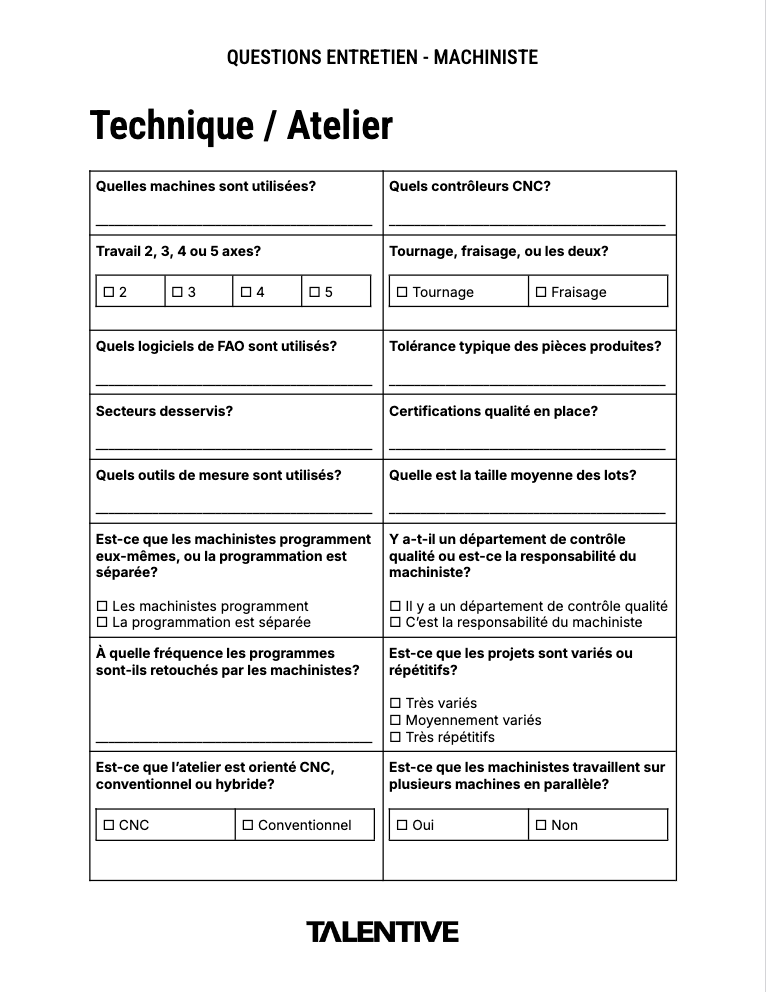
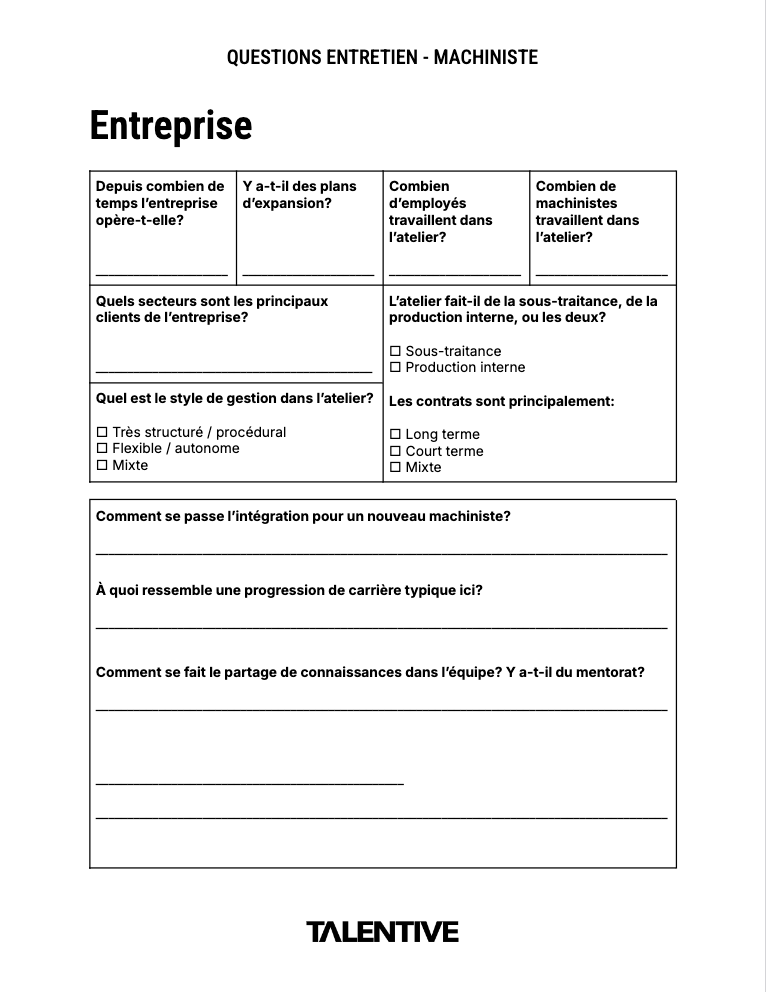
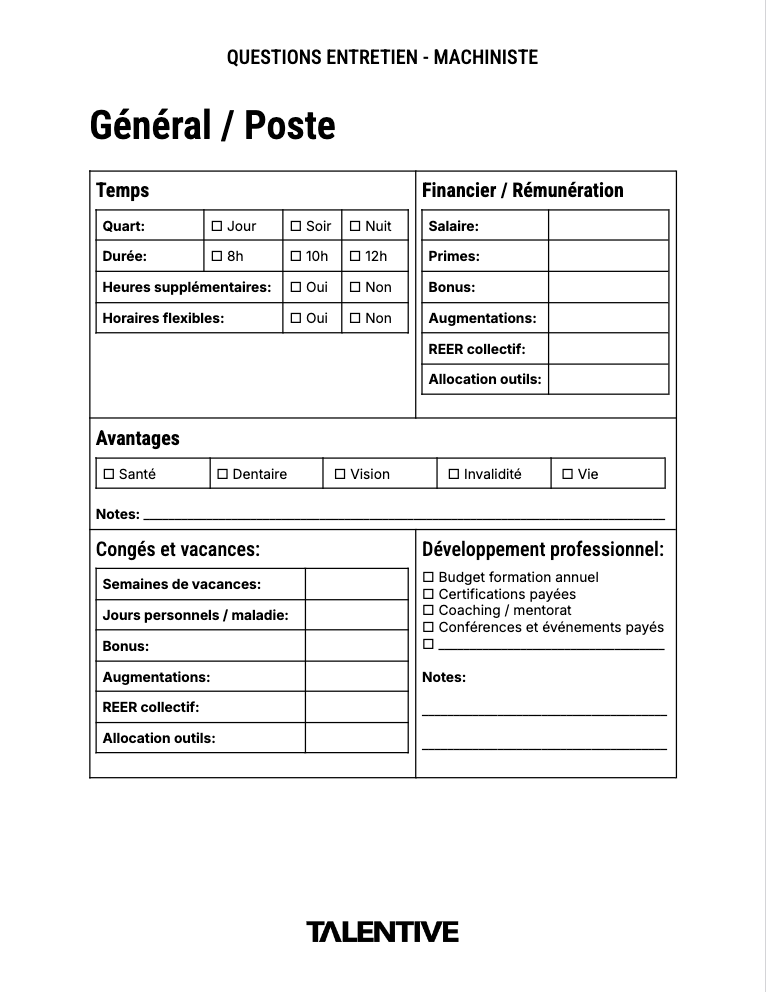
Printable PDF version of the questionnaire to help guide you during the interview.
Technical / Shop Floor
- What machines are used in the shop? (brands and models – Haas, Mazak, DMG Mori, etc.)
- What types of parts are mainly machined?
- Are projects varied or repetitive?
- Is the shop oriented toward CNC, conventional machining, or a hybrid setup?
- Do machinists often work on multiple machines at the same time?
- Which CNC controls are used? (Fanuc, Siemens, Heidenhain, Mitsubishi)
- Is the work primarily 2-axis, 3-axis, 4-axis, or 5-axis machining?
- Is the work focused on turning, milling, or both?
- Which CAM software is used? (Mastercam, Fusion 360, GibbsCAM, etc.)
- Do machinists program their own jobs, or is programming handled separately?
- What are the typical tolerances of the parts being produced?
- Which industries do you serve? (aerospace, medical, automotive, defense—each has different quality requirements)
- What quality certifications does the company maintain? (ISO 9001, AS9100, etc.)
- What inspection and measurement equipment is used? (CMMs, micrometers, calipers, gauges)
- Is there a dedicated quality control department, or is inspection the machinist’s responsibility?
- What is the typical batch size? (high-volume production versus one-off parts)
- How often do machinists modify or optimize CNC programs?
- How is knowledge shared within the team? Is there a mentorship program?
Company
- Which industries represent your primary customer base?
- Does the shop focus on contract manufacturing, in-house production, or both?
- How long has the company been in operation?
- Are there plans for expansion or investment in new equipment?
- How many employees work in the shop?
General / Position
- What is the work schedule? (day, evening, or night shifts – and shift lengths such as 8, 10, or 12 hours)
- Is overtime common?
- What is the compensation package? (including shift premiums if applicable)
- What benefits are offered? (health insurance, retirement plans, vacation, etc.)
- How many weeks of vacation are provided?
- Is there a professional development program? (training, paid certifications, continuing education)
- What does the onboarding process look like for a new machinist?
- What does a typical career path look like within the company?
- How do you define success in this role?
- How many machinists are currently on the team?
- What level of autonomy is expected on a day-to-day basis?
Technical questions are especially important in machining because the machine fleet directly determines what you’ll be doing every day – and whether you’ll continue to develop your skills or stagnate. A shop running 3-axis Haas machines with Mastercam offers a very different experience from a shop running 5-axis Mazak equipment with dedicated offline programming.
Related: How to resign from your job
Related: Managing counteroffers
Download the printable version of the questionnaire (PDF)
Arrive prepared with this questionnaire designed specifically to help machinists during job interviews. Over 30 questions to better evaluate the workshop, equipment, team, and working conditions.
We also share the best machining job opportunities in Quebec as well as manufacturing market trends – you can unsubscribe at any time.